

Blog Key Facts: How EMDR Heals Trauma
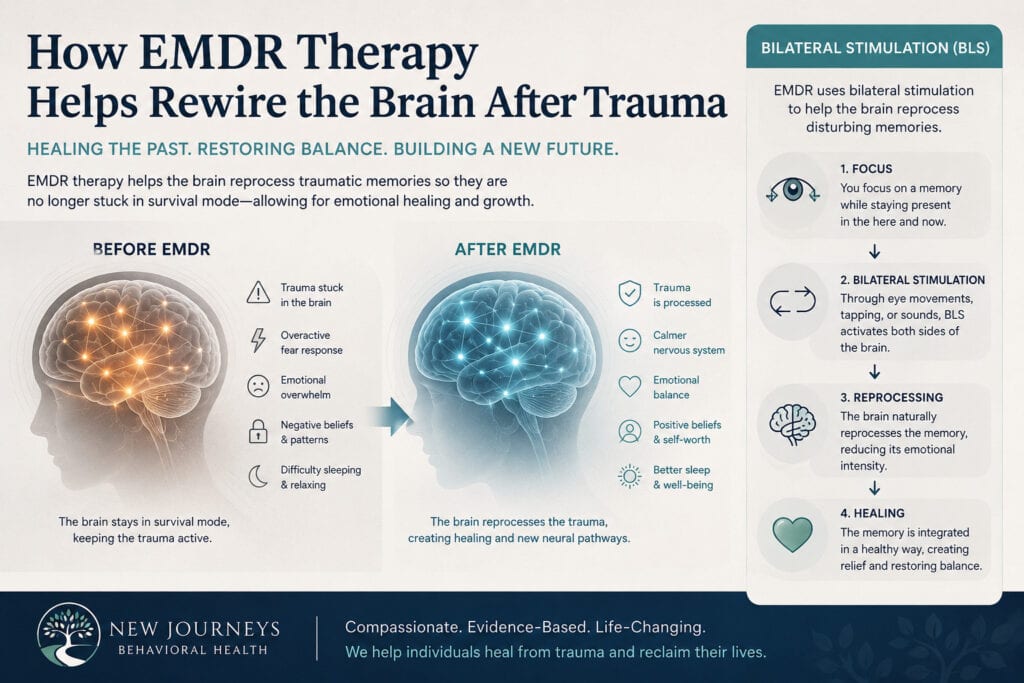
The Problem: Trauma freezes memories in the brain’s emotional center, causing you to constantly relive past distress.
The Fix: EMDR therapy uses guided bilateral stimulation (like side-to-side eye movements) to unlock those memories and kickstart the brain’s natural healing process.
The Result: It deactivates your brain’s alarm system (the amygdala) and physically re-files the trauma into safe, long-term memory—stripping away the painful emotional trigger.
The Proof: Clinical data shows 77% to 90% of individuals achieve complete PTSD remission in just 3 to 8 sessions.
Next Steps: At New Journeys Behavioral Health in Irvine, CA, we provide specialized, psychiatrist-led EMDR therapy in an intimate, 6-bed luxury environment. Start your healing journey here.
Experiencing a traumatic event can leave you feeling trapped in a continuous loop of distress. Whether it is an isolated incident or prolonged exposure to severe stress, trauma fundamentally alters how your brain handles information. For individuals living in Southern California who are struggling to shake the grip of past events, traditional talk therapy can sometimes feel like it only scratches the surface.
This is where Eye Movement Desensitization and Reprocessing (EMDR) therapy comes in. As an advanced, evidence-based neurobiological treatment, EMDR doesn’t just help you manage your symptoms, it actively helps the brain rewire and heal itself.
The Neurobiology of Trauma: Why the Brain Gets “Stuck”
To understand why EMDR is so effective for trauma and PTSD recovery, we have to look at what happens to the brain during a traumatic event.
Normally, when you experience something day-to-day, your brain processes the memory, extracts the useful information, and stores it away neatly in your long-term memory network. This processing is heavily managed by the amygdala (the brain’s alarm system) and the hippocampus (the brain’s filing cabinet).
However, when a highly distressing or traumatic event occurs, the brain’s survival mechanism takes over. The intense surge of stress hormones knocks the normal processing system offline. Instead of being properly filed away, the memory gets “frozen” in its raw, unprocessed state within the nervous system. When a memory is stuck in the emotional right hemisphere of the brain, it retains its original intensity. Years later, a specific sight, sound, or smell in your environment can trigger that unprocessed memory. Your brain misinterprets the trigger as an active threat, causing you to experience the same panic, anxiety, or flashbacks as if the trauma were happening all over again.
How EMDR Therapy Rewires the Brain
EMDR therapy targets these frozen memory networks directly using bilateral stimulation (BLS), typically achieved through guided, side-to-side eye movements, alternating auditory tones, or rhythmic tactile taps.
This structural processing mimics the natural memory-sorting behavior that occurs during Rapid Eye Movement (REM) sleep. By introducing bilateral stimulation while you briefly focus on the traumatic memory, EMDR achieves three critical neurological shifts:
Dampens the Amygdala: BLS sends a physiological signal of safety to your nervous system. This deactivates the amygdala’s alarm response, allowing you to face the memory without entering a full fight-or-flight state.
Stimulates Interhemispheric Communication: It forces the left (logical) and right (emotional) hemispheres of your brain to communicate. This helps integrate the emotional weight of the memory with logical context (“I am safe now; that event is in the past”).
Facilitates Neuroplasticity: The brain literally physically rewires itself, moving the trauma from an active emotional trigger site into standard, declarative long-term memory storage.
Ultimately, the goal of EMDR therapy is not to make you forget what happened. Instead, it strips away the painful emotional charge, leaving you with the factual memory of the event without the accompanying physical and psychological panic.
What the Data Shows: EMDR Clinically Proven by the Numbers
EMDR is not a experimental treatment; it is one of the most thoroughly researched and validated psychotherapies for trauma in the world, recognized by major global and national health organizations.
According to a clinical review published in the National Institutes of Health PMC10418657, multiple randomized controlled trials found that 77% to 90% of individuals with single-event PTSD achieved complete remission after just three to eight 90-minute EMDR therapy sessions.
Furthermore, a comprehensive meta-analysis hosted by the National Library of Medicine (PMC4125321) analyzed decades of clinical trials and confirmed that EMDR yields large, stable reductions across multiple symptoms:
Significant decreases in core PTSD symptoms (intrusive flashbacks and hypervigilance).
Measurable reductions in secondary trauma symptoms, specifically clinical anxiety and deep depression.
High treatment retention rates, with significantly lower patient dropout percentages compared to traditional exposure therapies, because EMDR does not require extensive verbal descriptions or repetitive homework.
Specialized EMDR and Trauma Recovery in Orange County
If you or a loved one is seeking professional support to process past trauma, finding specialized care locally is crucial. At New Journeys Behavioral Health, located in Irvine, California, we provide a structured, compassionate environment specifically optimized for deep trauma resolution.
Our clinical team integrates advanced EMDR therapy directly into our personalized, inpatient mental health program. Rather than relying solely on traditional outpatient talk therapy, we utilize a comprehensive, psychiatrist-led framework within our luxury residential facility. Keeping our census limited to a maximum of six clients allows us to deliver a highly supportive 3:1 staff ratio, ensuring that intensive trauma processing is paired with the exact emotional containment, safety, and pacing required for true neurological healing.
You do not have to live your life at the mercy of unprocessed past experiences. To learn more about how our trauma-informed team can support your recovery, reach out to our Irvine admissions team today at (866) 954-6899 to schedule a confidential assessment.